
· Dana Whitlock
Why the First Shot of the Day Runs Differently
This is the shot that sends people to the grinder for no reason. Everything was right yesterday evening, the same beans are in the hopper, the same number is on the scale, and the first coffee of the morning comes out wrong anyway. On an open base you can watch it happen, which is useful, and you can also misread it, which is expensive in beans.
What is actually cold
Your machine tells you it is ready long before it is. The boiler reaches temperature quickly because it is heating water, and water is the easy part. The metal is the slow part, and there is more of it in the path than most people picture.
Water leaves the group at brewing temperature and immediately starts giving heat away to everything it touches. It touches the shower screen, the group head itself, the rim and body of the portafilter, the basket sitting inside it, and finally the cup. Every one of those is a piece of metal or ceramic that spent the night at room temperature, and every one of them takes its share before the coffee gets any.
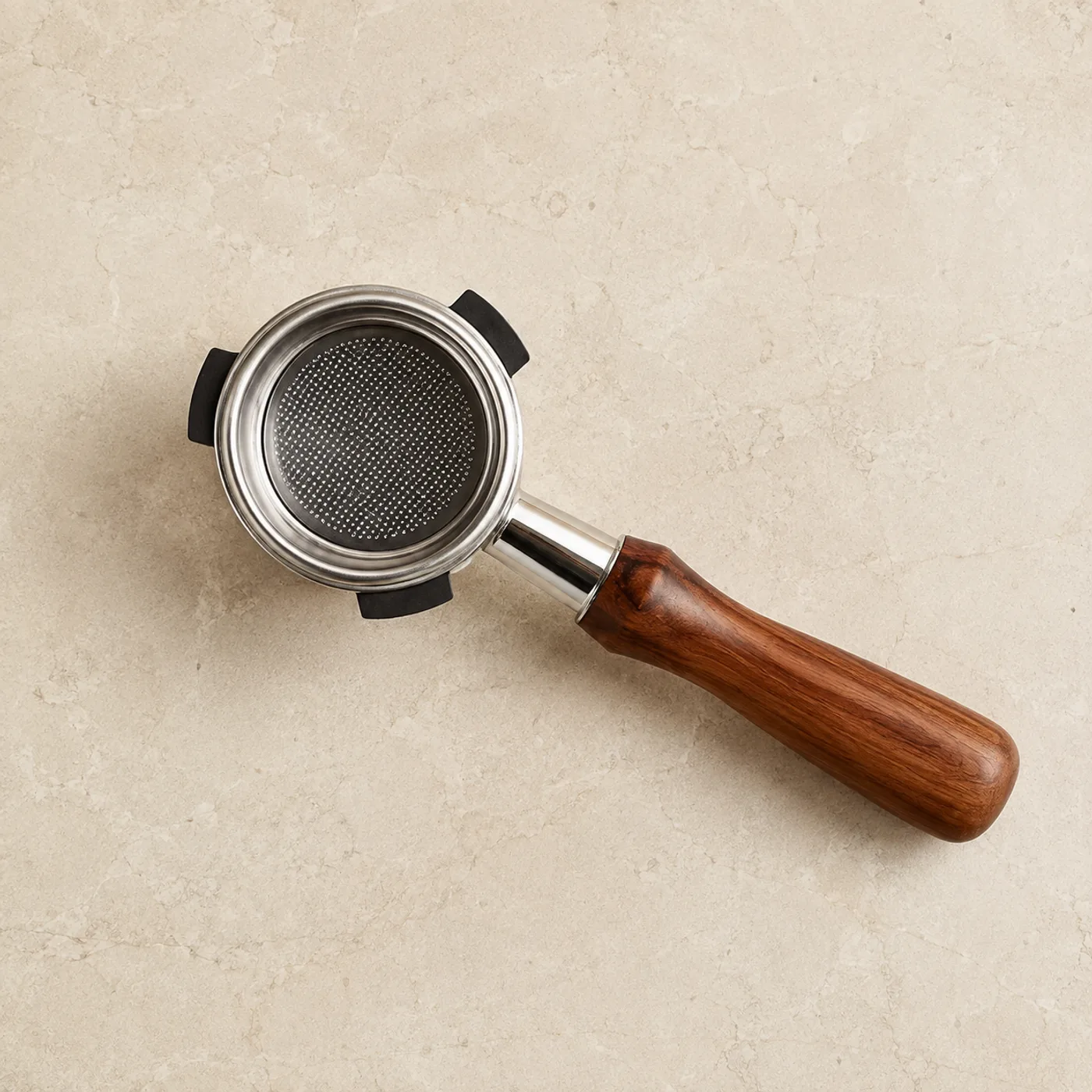
The portafilter is the piece people forget, because it is the piece that lives outside the machine. It is also, on most home setups, the single largest lump of cold steel in the path. The head is stainless steel precisely so that it holds heat steady once it is warm, and the same property works against you for the first few minutes: metal that holds heat well also takes a while to accept it.
What a cold start looks like at the open base
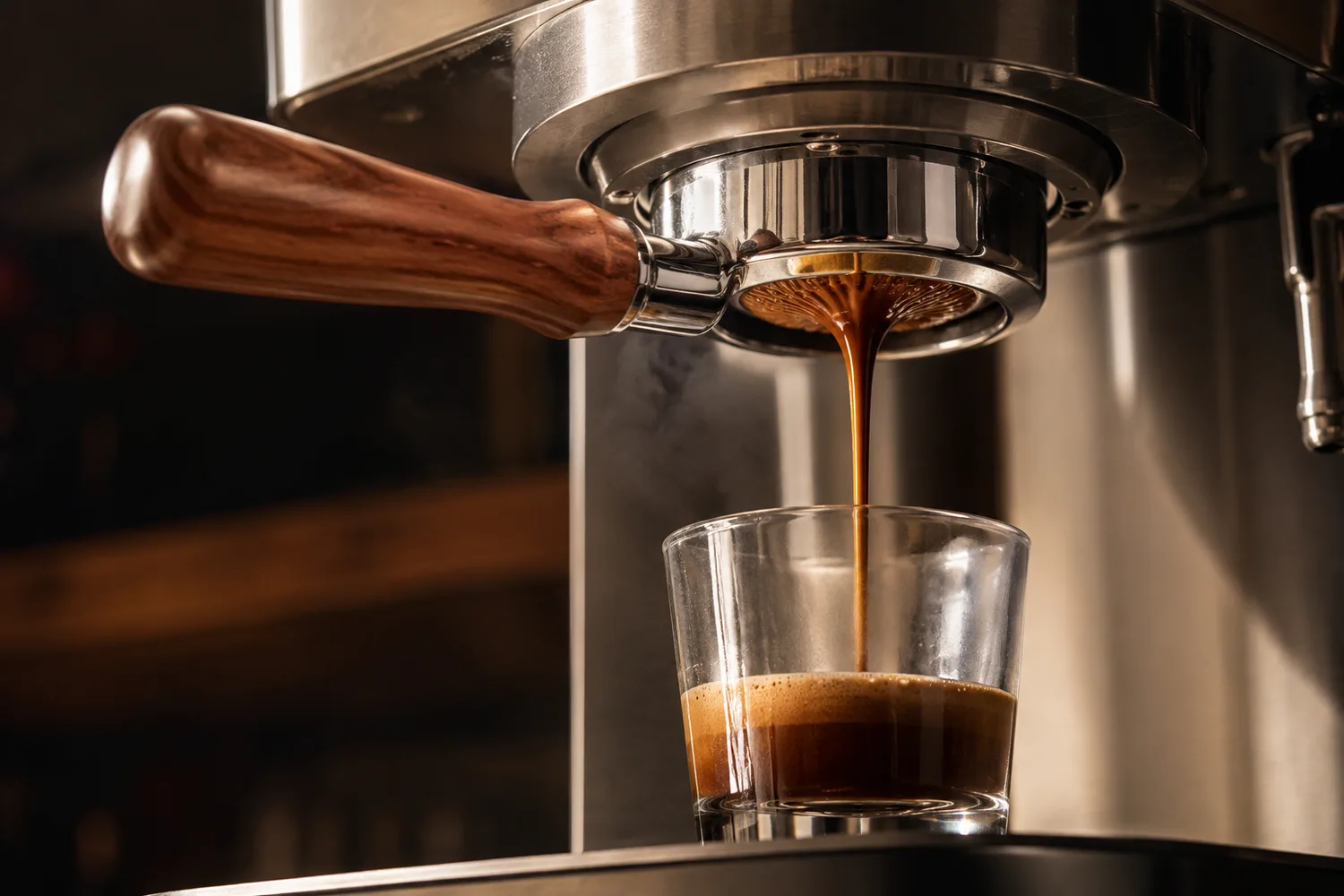
This is where a bottomless portafilter earns its keep, because the effect is visible rather than inferred. On a shot pulled through cold metal, the beginning of the flow behaves differently from the rest of it.
The first liquid is pale and reluctant. Instead of a dark bead gathering near the centre, you get something thinner and lighter that takes its time. Cooler water extracts less, and less extraction is exactly what a pale first drop means.
The flow catches up mid-shot. This is the tell that separates a thermal problem from a puck problem, and it is worth learning. As the shot runs, the metal warms, and the stream darkens and thickens partway through as though it changed its mind. A puck fault does not do that. Channeling gets worse as the bed erodes, not better.
The cup tastes sour and thin rather than harsh. Under-extraction from temperature reads as sourness and a watery body, not as the dry bitterness that comes from running a shot too long.
None of this is the portafilter misbehaving. It is the open base reporting a temperature problem with the same honesty it reports a distribution problem, and the two look different enough to tell apart once you know which one you are looking at.
Why winter makes it worse
The size of the effect depends on how far the metal has to travel to get to brewing temperature, and that depends on the room. A kitchen that sits at a comfortable temperature all summer is a very different starting point from the same kitchen at seven in the morning in January, after the heating has been off all night.
This is why so many people meet the problem for the first time in winter, and why it so often arrives at the same moment as a new machine. Espresso equipment is given as a gift more than it is bought on a whim, which means an enormous number of first shots are pulled in the coldest weeks of the year, by someone who has nothing to compare them against. The shot runs badly, the beans get blamed, the grinder gets moved, and the actual cause is the counter the portafilter was resting on.
The same person pulling the same shot in June would have had a smaller problem and might never have noticed it. Nothing about the equipment changed. The room did.
The mistake it causes: moving a grinder that was right
Here is the sequence that costs people a fortnight. The first shot of the day runs fast and tastes sour, which are the classic symptoms of a grind that is too coarse. So the grinder goes finer. The second shot, pulled through metal that is now warm from the first, comes out better, which appears to confirm the diagnosis. The grind stays where it was moved to.
The next morning the same thing happens from the new setting, and the grinder goes finer again. Within a week the grind is far finer than it needs to be, the afternoon shots are choking and bitter, and every morning still starts badly. Two variables were moving and only one was being watched.
The rule that prevents all of it: never dial against the first shot of the day. Pull it, drink it or discard it, and make your judgements from the second one onwards. A cold shot is not a data point about your coffee. It is a data point about your kitchen.
If the fault is still there on the third and fourth shots, then it is genuinely a puck fault and worth chasing properly. Why a bottomless portafilter sprays takes those causes in order of likelihood, and reading the puck afterwards confirms from the other side what the base showed you during the shot.
Warming the metal, in the order that matters
The fix is the one every cafe uses without thinking about it, and it costs nothing but a little patience before the first coffee.
Leave the portafilter locked into the group. This is the single habit that does the most. A portafilter that lives in the machine between shots is already at the machine's temperature when you want it, and it never has to be warmed at all. Take it out to fill it, put it straight back.
Run water through before the first coffee. With the portafilter locked in and empty, run the pump. Hot water passing through the group and the head warms both far faster than standing there waiting will, and it flushes yesterday's residue off the screen while it is at it.
Warm the cup too. A cold cup takes its share from a shot that is already small. Standing it on top of the machine while you grind warms it enough, and the shot lands in something that holds its temperature instead of taking it.
How much of this matters depends on how much metal you have. A larger head is more thermal mass to bring up to temperature, which is why the effect is most pronounced on the biggest fit; the 58 mm page goes into what that changes in practice. The same mass that is slow to warm is what then holds the temperature steady through the shot, which is the reason the steel is there at all, and it is one of the criteria we test against in how we test.
The basket is the other cold piece
Warming the portafilter and forgetting the basket is a common half-measure, and it is worth understanding why the basket matters out of proportion to its size.
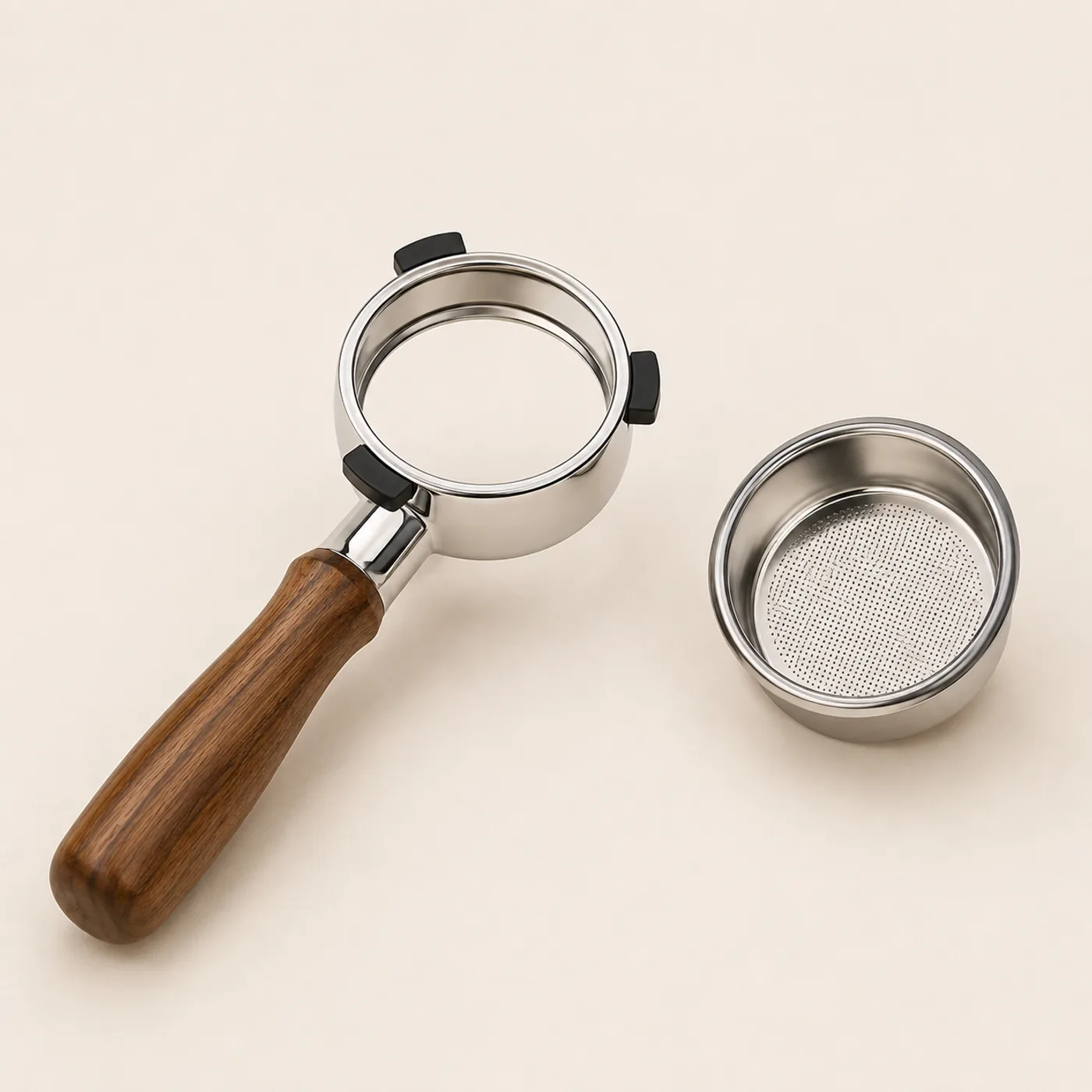
The basket is the only piece of metal in direct contact with the coffee bed. The head can be perfectly warm while the basket sitting inside it is not, and the basket is the one touching the grounds. If it lives in a drawer and gets dropped into a warm head at the last second, it arrives cold at exactly the wrong moment.
Keeping the basket in the portafilter, and the portafilter in the group, solves this without any extra step. The basket warms alongside the head, and the only thing that leaves the machine is the whole assembly, together, for as long as it takes to dose and tamp.
One thing worth checking while you are there: a basket that is not seating flat will read as a fault on every shot regardless of temperature. If the same jet appears in the same place every time, warm or cold, the seat and the rim are where to look, and cleaning them is usually the fix.
What warming up does not fix
Temperature explains the difference between your first shot and your second. It does not explain a shot that is wrong all day, and it is worth being clear about the boundary so that warm metal does not become the new thing that gets blamed.
It does not fix distribution. A jet firing sideways from the same spot on every shot, at any temperature, is water finding a channel through an uneven bed. Break up the clumps and level the bed before tamping.
It does not fix a dose that does not match the basket. Too little coffee for the space and the bed lifts; too much and it presses against the screen. Neither changes with warmth.
It does not fix the wrong basket. If you are still using the pressurized basket that came with the machine, the flow is being forced through a single hole by design and there is nothing at the base to read. Pressurized versus non-pressurized explains how to tell which one you have from underneath.
The quick table
| What you see | Thermal or puck? | What to do |
|---|---|---|
| Pale, slow start that darkens partway through | Thermal | Warm the metal, judge from the second shot |
| Only the first shot of the day is wrong | Thermal | Leave the portafilter locked in overnight |
| Sour and thin, no bitterness | Usually thermal | Run water through the group first |
| A jet from the same place, every shot | Puck or seat | Level the bed; check the basket seats flat |
| Wrong on every shot, all day | Puck | Distribution first, then dose, then grind |
| One thin stream through a single hole | Neither | Swap to the non-pressurized basket |
The reason to settle temperature before anything else is that it is the only variable on the list you can remove completely. Distribution, dose and grind all have to be judged. A portafilter left in the group is either there or it is not, and once it is, every shot you pull afterwards is telling you about the coffee rather than about the room.
Get the metal warm, then change one thing at a time, and the open base becomes what it is supposed to be: a straight answer about the shot in front of you.
Where to go next
If the spray is still there once everything is warm, the spraying guide takes the causes in order. If you want the fuller picture of what an open base shows and why the spout hid it, the main page covers the whole extraction from the first drop to blonding.

Dana Whitlock · Home espresso tester
Pulls shots on a domestic single-boiler machine every morning and writes down what changed. Most of what appears here comes from watching the same faults repeat across four portafilter fits and a lot of wasted coffee.