
· Dana Whitlock
DIY Bottomless Portafilter
The idea arrives about ten seconds after someone watches an open-base shot for the first time and then looks at the portafilter already sitting in their machine. This page is about what that job actually involves, and it does not set out a method for doing it.
Where the DIY bottomless portafilter idea comes from
The appeal is real, and it is specific. An open base ends the guessing. Channeling announces itself as a jet leaving the puck at an angle, blonding arrives where you can watch it, and a bad tamp stops being something you reconstruct from taste afterwards. Everything a spout hides happens in plain view instead, on the shot you are actually pulling. That is the whole reason anybody wants one, and the comparison between the two goes through it in detail.
The reasoning that follows is what makes the job look small. The portafilter in the machine already fits the group head. It already holds the basket. The only visible difference between it and the one in the video is a spout on the underside. So the difference reads as metal, and metal reads as something that could come off.
It is a tidy chain of logic and it skips one step: the spout is not the only thing living in that metal. Two of the surfaces that decide how every shot extracts are down there with it, and the rest of this page is about them.
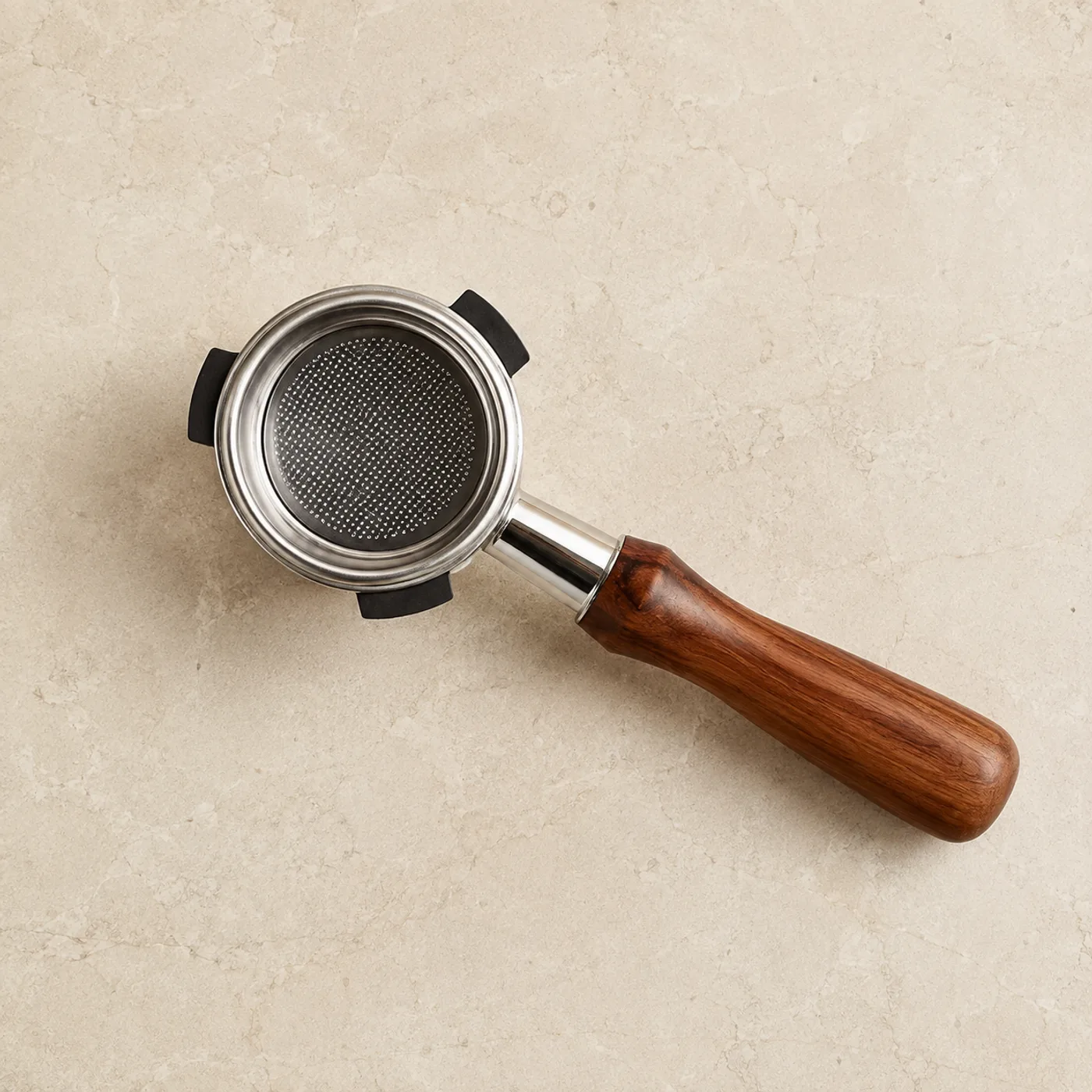
What people attempt, and what this page does not set out
Three broad approaches come up whenever the subject appears. Some people take the spouted underside off the head entirely. Some try to open out the floor the basket sits on and leave the rest of the head alone. Some hand the part to somebody with a workshop and ask for it back with the bottom opened up.
You will not find a method for any of them here. No sequence, no tooling, no measurements, no temperatures. That is deliberate: a portafilter is not a bracket, and the next section is about the difference.
What follows instead is the part of the question that a method would not answer anyway. What is the piece doing while the shot runs. Which surfaces decide the extraction, and where they sit. What a fault in one of them looks like at the group head. And which of it can be checked afterwards by the person holding the result.
What the part is doing while the shot runs
A portafilter looks like a handle with a metal cup on the end, and it behaves like a pressure fitting. Its outer rim presses against the group gasket, and the quality of that seal decides whether the pump drives water through the coffee or around the edge of it. Hot water passes through the head on its way to the basket, twice a day or twenty times, depending on the household.
It is also under mechanical load constantly. The head takes a twisting load every single time it is locked into the group and unlocked again, and it heat-cycles on the same schedule: hot through the shot, cooling on the counter, hot again tomorrow morning. That cycle is the reason handles work loose over months on portafilters that nobody has ever touched with a tool.
So metal taken off the underside is metal taken off a component that is already sealing, already carrying hot water, and already being wound and unwound and heat-cycled every day, at arm's length from the hands and the face of whoever is pulling the shot. The part does not become a different category of object because the coffee is domestic.
The two surfaces that decide the shot
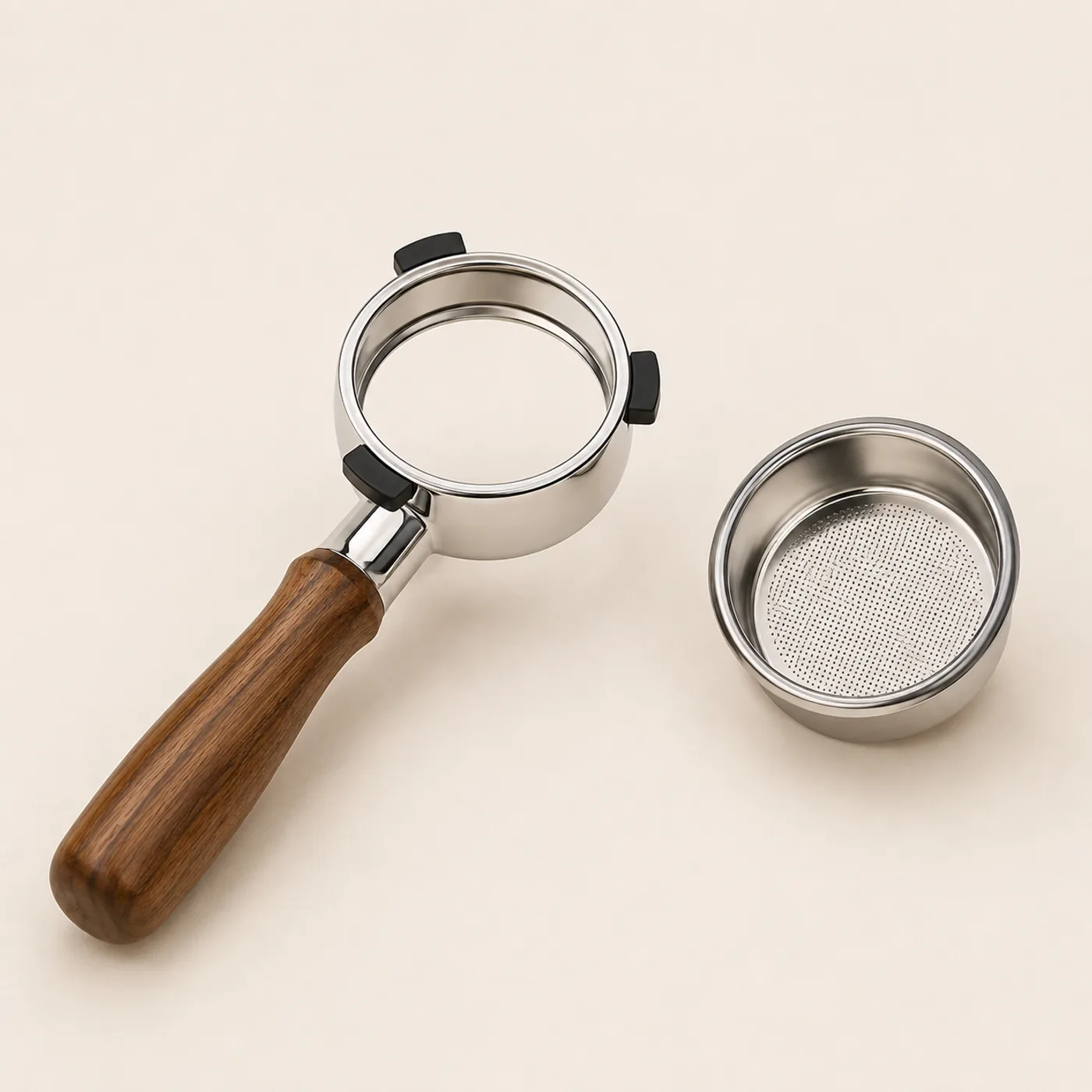
Inside the head there is a machined ledge that the basket rests on. It is turned flat, and flat is not a finish detail. A ledge that ends up even slightly out of true sets the basket at an angle, and once the basket sits at an angle every shot extracts unevenly no matter how carefully the bed is levelled or how patiently the grind is moved. The signature is unmistakable once you know it: a jet firing from the same place on the puck, every shot, forever.
The second surface is the rim on the outside, the one that meets the group gasket. A burr, a rough machining line or a chamfer that has gone too far and the seal seeps. On a bottomless portafilter you see it immediately, as water creeping round the outside edge before the shot proper has begun. The six checks that separate a good bottomless portafilter from a poor one put these two at second and third place for exactly this reason.
Both of those surfaces live in the metal at the bottom of the head. That is the region an alteration passes through, and it is the reason the job is not the small one it looks like. There is a ten-second check for the seat, and it is a good one: drop the basket in, hold the head up to a light and turn it, watching whether the gap between basket rim and seat stays even the whole way round. It tells you whether a seat is flat. It does not put a seat back.
What a fault at the group head looks like
The everyday failures are the ones already familiar from the rest of this blog, which is what makes them so difficult to diagnose on a part that has been altered. Seepage round the outside reads as a gasket problem. A jet from one spot reads as a distribution problem. A sour, thin start reads as a grind problem. Someone can spend weeks moving a grinder to chase a fault that was machined in.
| Surface | What it does during the shot | What a fault there looks like |
|---|---|---|
| Basket seat | Carries the basket level, so the bed extracts evenly | A jet from the same spot on the puck, every single shot |
| Sealing rim | Presses against the group gasket so pressure goes through the coffee | Water creeping round the outside edge before the shot starts |
| Open base | Leaves the underside of the puck in view, with nothing to catch the flow | A lip or a step that breaks the stream and hides what it was doing |
| Head mass | Holds heat through the shot instead of taking it out of the water | A sour, thin start to a shot that is otherwise correct |
Then there is the failure that is not a coffee problem. A portafilter that has been cut, thinned or reshaped is holding hot water under pump pressure, locked into a group head, inches from the hands and the face of the person watching the shot. A part that lets go there scalds and takes the group with it. Nothing available at a kitchen counter establishes that a reshaped part will hold, and the fault would not announce itself in advance.
The threshold is simple. If any portafilter starts to seep at the rim, moves in the group, seats differently at lock-in, or sounds different when it locks, take it out of service and stop pulling shots with it. That applies to a part in original condition. On a part that has been worked on, it applies with nothing to weigh it against.
The basket question a DIY bottomless portafilter leaves open
Home espresso machines are generally supplied with a pressurized basket. It has a second floor underneath with a single small hole in it, and it exists so that coarsely ground coffee still produces crema. That is what lets a machine put a head on a cup made from pre-ground supermarket coffee on day one, and it is why almost every machine leaves the factory with one fitted.
On an open base it shows nothing at all. Every drop is forced through one point by design, so there is no puck releasing across a field of holes and therefore nothing to read. A single stream from a valve looks similar to a well-behaved shot and means nothing about the coffee. The difference between the two basket types is the piece of this that surprises most people.
Reshaping a head does not change which basket is in it. The single-wall basket is a separate part and a separate purchase, and it is the one that actually gives the open base something to show. Every Puckwell portafilter ships with a 2-cup non-pressurized basket in the box, which is why the open base does its job from the first shot rather than from the second order.
Warranty, and what a DIY bottomless portafilter stops being
A portafilter that has been cut is no longer the item its warranty covered. There is nothing to send back and nothing to claim against, and that is true from the first pass of any tool, whoever held it. On the machine side, damage traced to a part somebody altered is not a warranty claim either. The parts that take that damage are the group head and its gasket, which are the expensive end of a home espresso machine rather than the cheap end.
There is a second thing an alteration ends. The original part was produced to a specification and checked against it, whatever that specification happens to be for that piece. A part reshaped afterwards has been through none of those checks, and nothing at a kitchen counter reproduces them. It is not that the result is unknown in some abstract sense: it is that the two surfaces the whole extraction depends on have been moved, and the only thing left to judge them by is a shot with every other variable still in play.
And it runs one way. The spouted portafilter that came with the machine is also the one that splits a stream into two cups at once, which no bottomless portafilter does. Opening its underside retires that ability along with the spout.
What a purpose-made bottomless portafilter arrives with
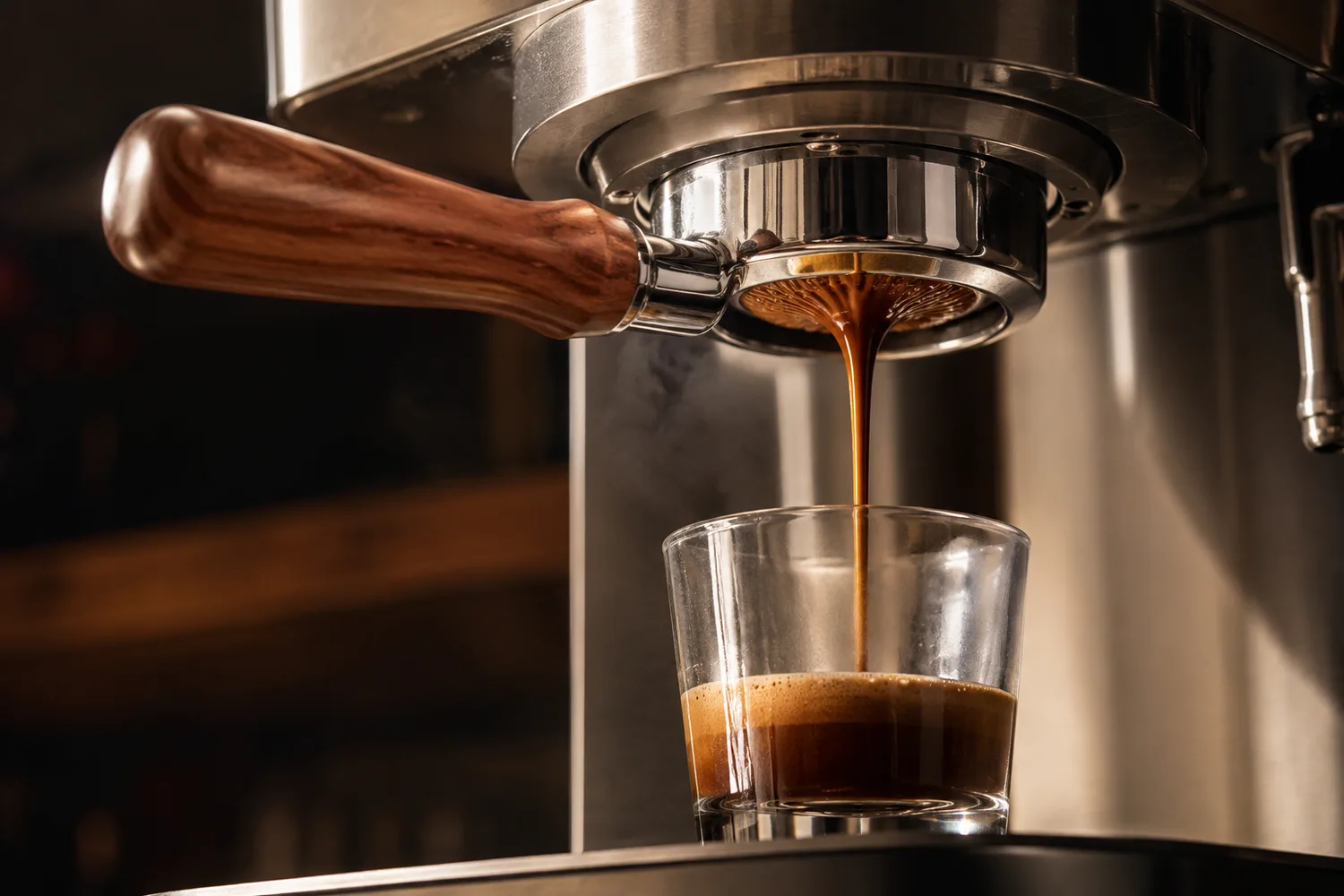
The piece built for the job starts from the surfaces the previous sections were about. The base is a single clean opening with no lip and no step, so nothing interrupts the view of the puck or catches the flow on the way out. The ledge the basket rests on is turned flat, so the basket drops in level and lifts straight back out for rinsing. The rim that meets the gasket is finished to seal against it. The head is stainless steel, which is where the thermal mass comes from and therefore why the first part of the shot is not chilled on its way through.
The handle is held by a chrome collar and a captive end cap, so the twisting load at every lock-in goes through the fixing rather than through the wood. Turned solid hardwood in rosewood, beech or a dark chocolate grain, or a moulded black for anyone who prefers it. And the 2-cup non-pressurized basket is in the box rather than sold separately.
Fit is decided before any of it, by machine model rather than by a diameter. Four fits cover it: 51 mm with two lugs, 51 mm with three lugs, 54 mm and 58 mm. Two machines can take the same basket diameter and still need different portafilters, because the lugs that lock into the group head are arranged differently, so the size guide lists fits against the model numbers printed on the machines themselves. Shipping is free, returns run for 30 days, and if a model is not on the table the number can be checked before an order goes out.
Where to go next
If the open base is new to you, the four habits it grades every shot on covers distribution, the tamp, the lock-in and reading the stream from the first drop. If you are weighing the change itself, bottomless versus regular sets out what moves and what stays the same. And the main page carries the full fit table alongside the range.

Dana Whitlock · Espresso guides editor
Writes the Puckwell guides to bottomless portafilters: machine fit, puck preparation and reading a shot while it runs.